Proudly part of Cardiff Metropolitan University



Human-Centred AI in Practice Building Fair AI Products
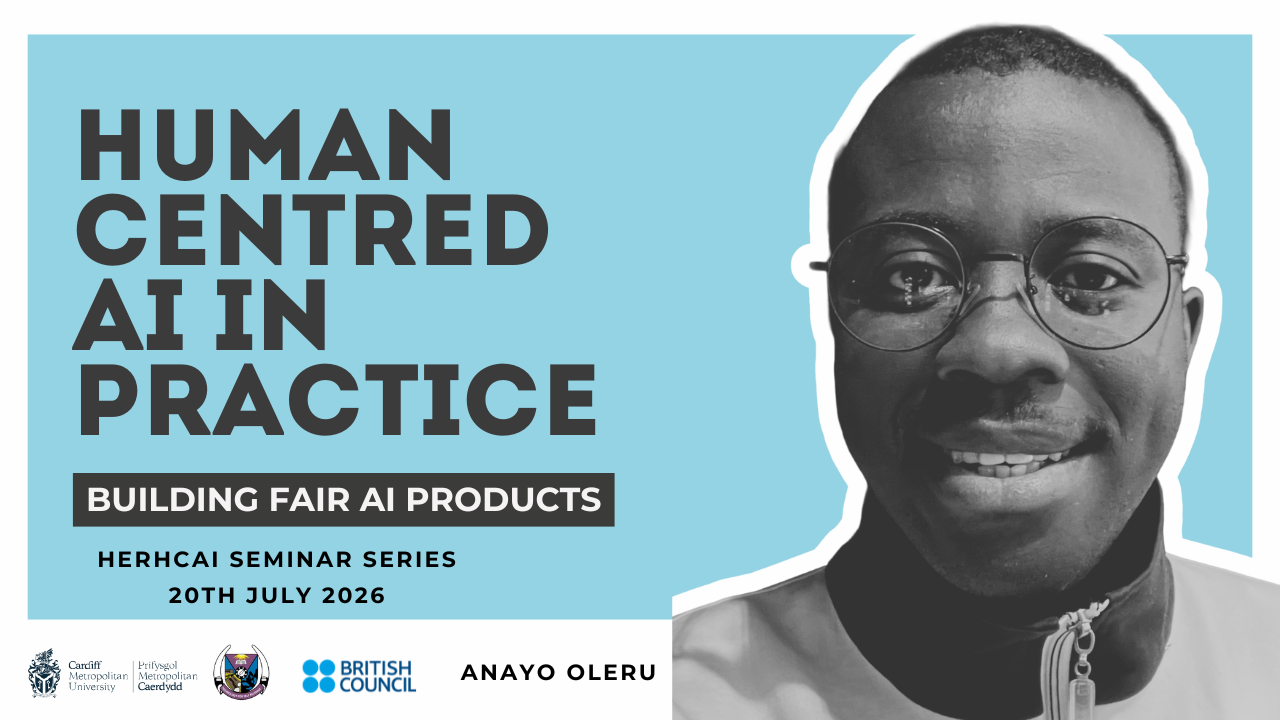
HerHCAI Seminar Series | 20 July 2026 | Speaker: Anayo Oleru, Technical Co-founder, Civeex
As part of the HerHCAI seminar series leading up to our free 5-week Human-Centred AI course, we welcomed Anayo Oleru, software engineer, technical co-founder of Civeex, and mentor on the Google Africa Developer Programme for a 20-minute session on building AI products that are fair, transparent, and trustworthy.
Anayo traced the journey from early computing to today’s AI boom, showing how each era pushed technology closer to people: from human-computer interaction, to human-centred design, to today’s challenge — human-centred AI. He explained that as AI moved into life-changing decisions (loans, medical care, hiring, criminal justice), real harms emerged: Amazon’s recruitment tool that downgraded women’s CVs, a healthcare algorithm that underestimated the needs of Black patients, and credit systems that gave women lower limits than men with identical profiles. His core message: AI itself wasn’t the problem — the problem was trusting AI to make important decisions without fairness, transparency, explainability, or human oversight.
Drawing on how Civeex was designed, Anayo shared 10 principles for human-centred AI, distilled into four practical pillars, and showed how they work in a real product: Civeex’s AI analyses candidates’ experience in context and presents transparent, traceable insights but the hiring decision always stays with the human.
Key Takeaways
- Put humans at the centre. Human-centred AI places human needs, values, and capabilities at the forefront of AI design, development, and deployment.
- AI should inform, not decide. In high-stakes areas like hiring, AI should analyse and present insights people make the final call.
- Bias is real and has history. Amazon, Optum, and Apple cases show how biased data quietly produces discriminatory outcomes at scale.
- Bias correction is continuous, not one-off. Fairness requires ongoing monitoring and correction throughout a product’s life.
- Transparency builds trust. Users should understand what the AI did, what data it used, and how it reached its recommendation.
- Good AI amplifies people. The test of human-centred AI: does it replace human thinking, or make people more capable and their work better?
Join us next week, same time (12:00–12:20pm), for the next seminar in the series and register for the free 5-week Human-Centred AI course